The West India and Guinea Company 1671-1754
Vestindisk-guineisk Kompagni 1671-1754
The West India and Guinea Company was a typical enterprise of the
mercantilist age. The Company was organised on the same lines as modern limited
liability companies, i.e. with a board of directors, a day-to-day management,
and general meetings at which all shareholders had a say.
The West India and Guinea Company was founded by royal charter, under which
the Company was granted certain rights and assigned certain obligations. The
Company’s objects were trade and colonisation, and to administer the colony on
the crown’s behalf. The Company was granted a national monopoly on trade and
shipping to the West Indies and Guinea, preferential financial treatment, own
legal jurisdiction, and a monopoly on sugar refining in all the king’s
dominions. Its obligations were limited to sending ships regularly to the
colony, to selling a certain volume of Danish goods overseas, and to carrying
the king’s own goods free of charge, if required.
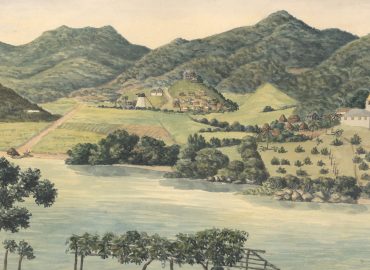
In 1672, Denmark acquired St. Thomas. During the 1670s, relatively few ships
were sent out and it was therefore a difficult period for the small community of
settlers on the island. They cultivated the land, planting sugar and tobacco on
plantations whose operation was, from the very beginning, based on African slave
labour. The financial problems of the West India and Guinea Company continued
into the 1680s, but the Company derived some income from duties levied on the
private shipping needed to maintain the colony. Similarly, in 1685, a treaty was
concluded with the German state of Brandenburg, which paid handsome fees for a
trading station on St. Thomas. From 1687 to 1696, the Company sent no ships of
its own, but leased its monopoly on trade to a Danish and a Norwegian merchant.
After the economic revival of the West India and Guinea Company in 1697, the
situation improved. In 1718, Denmark seized the neighbouring island of St. John,
for St. Thomas was by then completely under cultivation. But even more space was
required for plantations, and in 1733 St. Croix was acquired from the French and
the Danish West Indies reached its full, albeit modest, extent.
St. Croix was surveyed, parcelled out, and brought under cultivation in the
course of the 1730s and 1740s. During the remainder of the century, the fertile
island developed into an extremely rich sugar producer, while St. Thomas, with
its very fine harbour, became a centre of regional and international commerce
and shipping.
The West India and Guinea Company had its headquarters, administrative
buildings, warehouses, shipyard, and sugar refinery in Copenhagen. The Company’s
activities centred on trade and shipping, as well as on the administration of
the West India and Guinea colonies.
The Company’s monopoly was necessary to bring about the Danish colonisation
of the West Indies and ensure effective development. But around 1740, private
investors outside the Company were prepared to take over all its activities and
– since the Company had made itself redundant and its monopoly now actually
impeded progress both in the West Indies and in Denmark – the Danish
government decided, in 1754, to buy out the shareholders and liquidate the West
India and Guinea Company.
In 1755, the Danish government took over the administration of the Danish
West Indies and the Guinea establishments. At the same time, trade and shipping
to these colonies was deregulated and opened up to all subjects to the Danish
king.
Archives
The archives preserved from the West India and Guinea Company include 957
boxes and bound volumes and take up approximately 100 linear metres. A detailed
Danish catalogue of the archives is published in J. O. Bro-Jørgensen & Aa.
Rasch, Asiatiske, vestindiske og guineiske handelskompagnier, Vejledende
Arkivregistraturer, vol. 14, Copenhagen 1969, pp. 159-257, and on this site: The West India and Guinea Company.
On the Company’s liquidation in 1755, all of its archives were transferred
from the Company house to the Chamber of Revenue, i.e. the official agency that
took over the administration of the Danish West Indies.
Two years later, it seems that all archival documents considered superfluous
were discarded. Further discardings in 1796, 1799, 1807, and 1848 made heavy
inroads in the original archives. Discarded were the ledgers, journals, cash
books, and vouchers of the sugar refinery 1729-1754; many documents concerning
the Company’s shipping and trade, including almost all ships’ log books; and
a collection of three hundred boxes of Company orders regarding income and
expenditures 1696-1750.
Today, the archives of the West India and Guinea Company are organised in the
following seven main groups: A) The Company’s Copenhagen archives; B) Archives
sent home from the government secretariat of St. Thomas and St. John; C)
Archives sent home from the government secretariat on St. Croix; D) Accounts
sent home from St. Thomas and St. John; E) Accounts sent home from St. Croix
1734-1755; F) Archival material sent home from the government on the Guinea
coast 1698-1754; G) Accounts sent home from the Guinea coast 1698-1754. By far
the largest group is the first one, the Copenhagen archives, which represents
half the entire Company archives. The other half is almost completely made up of
various types of accounts sent home to Copenhagen from the West Indies and, to a
limited extent, from Guinea.
Literature
The litterature section of this site gives a survey of the general literature concerning the Danish West
Indies. Many of the works mentioned in that chapter treat the West India and
Guinea Company and the epoch 1671-1754 in greater or less depth. Literature
focusing specifically on the West India and Guinea Company is relatively
abundant: it is presented and discussed in Erik Gøbel, Danske oversøiske
handelskompagnier i 17. og 18. århundrede. En forskningsoversigt, Fortid og
Nutid, vol. 28, 1980, pp. 553-559.
The history of the West India and Guinea Company’s archives and their
survival to the present are described in J. O. Bro-Jørgensen & Aa. Rasch, Asiatiske,
vestindiske og guineiske handelskompagnier, Vejledende Arkivregistraturer,
vol. 14, Copenhagen 1969, pp. 161-164.
|