The Maps and Drawings Collection
The special collection of maps and drawings at the Danish National Archives comprises roughly 60,000 items. The collection was created for purely practical reasons, because the formats of maps and drawings tend to be much larger than the formats of other archival material. Traditionally, maps and drawings have therefore been stored in special cabinets or shelves, even when they were still held by the original archives-creating authority. After their transfer to the Danish National Archives, these approximately one hundred special collections have been kept separate and the order in which they were filed maintained. As is the case with other archival material, one needs a basic knowledge of administrative history and institutional jurisdiction in order to find what one is searching for.
It should be noted that a good many maps and drawings are to be found outside the Maps and Drawings Collection. They are often small-format maps and drawings, or large-format ones that have been folded to fit into the normal files of public authorities. It is also possible to find maps and drawings in many private archives (see
Private Individuals and Private
institutions) and in the Manuscript Collection, although a few of these have been transferred to the Maps and Drawings Collection.
Many of the maps – in and outside the Maps and Drawings Collection – are printed, and it is therefore possible to find other copies in the Danish National Archives and elsewhere. The drawings and manuscript maps, however, are unique specimens.
Some of the maps and drawings in the Danish National Archives have been photographed for preservation reasons. The exposures are kept in the so-called Security Photographs Collection, often in the form of negatives or diapositives in a 13x18 cm format. This is the case, for example, of group 25, described below.
The Royal Library also has a large collection of maps relevant to the Danish West Indies (see Chapter 20).
The West Indies
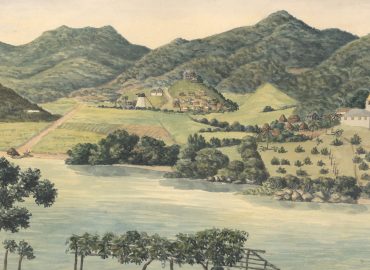
Most maps and drawings of the Danish West Indies before 1917 are to be found in group 25 of the Maps and Drawings Collection, which is the collection of the Central Directorate for the Colonies’ Colonial Office, originating in part from the old Chamber of Revenue. Altogether, these maps and drawings make up 300 items (Chamber of Revenue items nos. 337,1-337,634). The maps and drawings are of many different kinds, but roughly half of them are architectural drawings, chiefly of public buildings, such as forts (e.g. the detailed ground plan and bird’s eye view of Christiansfort on St. Croix March 1836 executed by lieutenants Giellerup and Friis, Chamber of Revenue items nos. 337,109 and 337,110); churches (e.g. Albert Løvmand’s three fine architectural drawings 1836 of the profile, facade and ground plan of the present Danish Lutheran church in Christiansted, items nos. 337,101-337,103); hospitals (e.g. three drawings by E. Kærn, March 1909, for the proposed mental department of the hospital at Richmond on St. Croix, items nos. 337,506-337,508); and the like. The collection includes maps (e.g. Peter Lotharius Oxholm’s original map of St. John surveyed 1780, item no. 337,209); technical drawings (e.g. a dozen architectural drawings for the floating dock in the port of St. Thomas, items nos. 337,535-337,544); street maps (e.g. an undated street map of Charlotte Amalie, apparently from around 1900, with lot numbers, item no. 337,425); and drawings of road systems (e.g. M. Thulstrup’s drawings for the replanning and sewerage of Kongensgade and Trompetergade in Charlotte Amalie from 1874 and 1872 respectively, items nos. 337,548 and 337,549). A group of 43 items (items nos. 337,300-337,343) consists of Peter Lotharius Oxholm’s fine detailed maps and drawings of islands, towns, and public buildings 1778-1779, which are appended to his comprehensive report of 30 August 1780 on the islands and their defences (the report is kept in the archives of the Chamber of Customs, see Chapter 24 items nos. 465-466).
The Chamber of Revenue collection also includes a few West Indian items other than those transferred to the Colonial Office, viz. two printed maps of St. John and St. Croix, both based on Oxholm’s drawings from the 1780s and 1790s (Chamber of Revenue items nos. 243,1 and 243,3); a printed map from 1849 of the Danish West Indies (item no. 243, 2); and a map of St. Thomas drawn by hand 1835-1839 by H. B. Hornbeck (item no. 243,4). Of a more recent date, there are three printed charts of Danish West Indian waters, viz. the ports of St. Thomas 1907 and Christiansted 1907 and the waters around St. Thomas and St. John 1914 (all under item no. 588); and finally, eighteen large-format tables of miscellaneous statistics of the Danish West Indies 1835-1857, chiefly concerning demographics (item no. 654A-654R).
It should also be mentioned that the very large groups, nos. 74-86, of the Maps and Drawings Collection, which contain Royal Danish Navy ship designs, etc., include drawings of such designs and ornaments for some of the Danish ships that sailed to the Danish West Indies from the middle of the 18th century. By way of example, there are 127 technical drawings of the frigate "Jylland", which visited the Danish West Indies five times between 1872 and 1887, depicting its hull, engine, rigging, ornamentation, etc. Among the Royal Danish Navy’s maps and drawings of subjects other than ships are an undated map of the Danish West Indies (no. D 507) and two maps of the ports of Charlotte Amalie (no. E 144) and Christiansted (no. E 145), both dated 1815 and drawn by harbour master Levin Jørgen Rohde.
The following are examples of the few maps and drawings removed from the archives of private individuals and filed in the Maps and Drawings Collection: from the private archives of major Theodor Cizeck Zeilau (private archives no.
6598), two artistic watercolours 1915 and 1916, painted by judge Segelcke at Frederiksted, depicting oxen-ploughing on Estate Prosperity and a prison gang cleaning the area at Fort Frederiksværn; from the same private archives, a sketch map of the West End of St. Croix, by Zeilau in 1916. From the private archives of harbour engineer H. C. V. Møller (private archives no.
6012), two folders of miscellaneous maps and drawings concerning his work on the port of St. Thomas 1904-1917 have been removed. This material comprises almost one hundred technical drawings as well as nautical charts and harbour maps, a few of these depicting the port of Christiansted.
A good number of maps and drawings concerning the Danish West Indies are also to be found outside the Maps and Drawings Collection. There is no thorough survey of this very scattered material. A few examples follow below, however.
Box 256 in the West India and Guinea Company’s archives contains a beautifully coloured map of Caret Bay and several surrounding plantations on St. Thomas 1728, and box 259 in the same archives contains a map of Christiansfort and its surroundings at Charlotte Amalie 1734. A handful of maps of the royal plantations on St. Croix 1733-1752 are to be found in box no. 2249.33 in the Chamber of Revenue archives
. Box no. 68 in Ernst Schimmelmann’s private archives (no. 6285) contains twenty or so maps and drawings of Estate La Grange on St. Croix, chiefly the fields and buildings of this large plantation 1746-1781. Boxes nos. 23 and 48 in the West India Trading Company’s archives (see Chapter 9) contain ground plans of the Company’s yard at Charlotte Amalie in 1805 and 1816 respectively. The Chamber of Customs’ West Indian and Guinean royal representations and resolutions 1824 (see Chapter 24, item no. 600) contain, in file no. 6, fine coloured drawings of the uniform, etc., worn by the governor of St. Thomas og St. John; the Chamber of Customs’ West Indian and Guinean cases contain, in box no. 473, coloured drawings of the uniforms of privates and non-commissioned and commissioned officers in the West Indian Military Forces; and the same group of miscellanea, box no. 429, contains a coloured elevation and ground plan for the slave schools erected in the 1830s by Peter von Scholten. The Manuscript Collection VII.D.8
includes an artistic drawing of the harbour square in Charlotte Amalie 1876. The archives left by the West Indian Commission of 1902 include a map of the incidence of leprosy on St. Croix, a drawing for the conversion of the Charlotte Amalie barracks into public offices, and a map of the port of Charlotte Amalie in which the various landowners’ estates along the bay are marked out.
A separate maps and drawings collection is that of the Military Archives, which comprises approximately 15,000 items. Among what are called geographical maps, i.e. small-scale maps, are ten or so concerning the Danish West Indies. Of manuscript maps, there are G. Oldenburg’s map of the West End of St. Croix 1816 (item no. G-II-778); an undated ground plan of Fort Christiansværn (item no. G-II-780); and three undated ground plans of Fort Frederiksværn (items nos. G-II-781 to G-II-783). There are also in the Military Archives (under item no. 1110-7873) five drawings 1899-1900 of the monument to the distinguished naval officer Carl Wilhelm Jessen, governor of St. Thomas 1822-1823, in the old Danish churchyard in Charlotte Amalie.
It should be added that a large collection of drawings of forts and other military facilities in the Danish West Indies and elsewhere have been removed from the archives of the Corps of Royal Engineers at the Danish National Archives and transferred to the Royal Library.
Finding Aids
The Maps and Drawings Collection is unevenly and rather poorly catalogued. In general, see the brief survey in Wilhelm von Rosen, ed., Rigsarkivet og hjælpemidlerne til dets benyttelse, vol. I:2, Copenhagen 1983, pp. 877-890.
Literature
A brief general introduction to the collections is found in Jørgen Nybo Rasmussen, Kort. Om kort og tegninger, Copenhagen 1991. The Navy’s portion of the drawings collection is treated in Hans Christian Bjerg, Søetatens kort- og tegningssamling, in Arkiv, vol. 4, 1973, pp. 209-231; see also the surveys in Hans Christian Bjerg & John Erichsen, Danske orlogsskibe 1690-1860. Konstruktion og dekoration, vols. 1-2, Copenhagen 1980.
|